Asia's Ports Race to Install Shore Power as IMO's Net-Zero Framework Nears Enforcement
China, Singapore, South Korea and Japan are fast-tracking shore power at their busiest container terminals as the IMO's global carbon-pricing framework for shipping edges toward formal adoption.
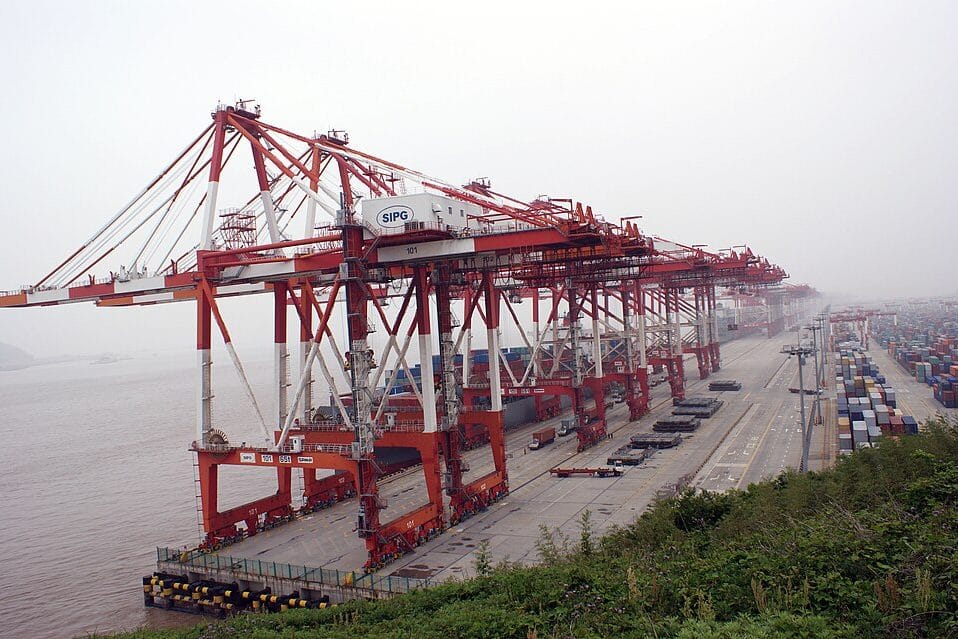
Container ships calling at Shanghai, Singapore, Busan and Yokohama are increasingly cutting their diesel generators at berth and plugging into the local electricity grid instead, as port authorities across Asia race to install shore power ahead of new global rules on shipping emissions. The push, which has accelerated through 2026, is driven by a mix of local air-quality mandates and the looming International Maritime Organization (IMO) Net-Zero Framework, a carbon-pricing and fuel-intensity system for international shipping that member states agreed on in principle in April 2025 and have since struggled to formally adopt.
Shore power — also called cold ironing or Onshore Power Supply (OPS) — lets a docked vessel shut down its auxiliary engines and draw electricity from the port's grid for lighting, refrigeration and onboard systems. At major container terminals, those auxiliary engines can burn several tonnes of marine fuel a day even while the ship goes nowhere, and in dense port cities that exhaust settles directly over residential neighbourhoods.
China's head start
No region has built shore power infrastructure faster than China. Since regulations tightened in the late 2010s, the Ministry of Transport has required new berths at major container and passenger terminals to be shore-power capable, and Shanghai, Ningbo-Zhoushan and Shenzhen now count shore power connections in the hundreds across their combined terminal networks. Shanghai's port operator has extended coverage to bulk and RoRo berths in addition to container terminals, and utilisation rates — the share of eligible calls that actually plug in rather than idle on diesel — have climbed steadily as tariffs for shore electricity have been kept below the cost of burning bunker fuel.
That price gap matters more than the hardware. A shore power berth is only useful if a shipping line has a financial reason to use it, and China's approach has combined mandatory infrastructure with subsidised electricity rates specifically to make idling on diesel the more expensive option. Regional governments around Shanghai and Guangdong have also layered in local subsidies for retrofitting older vessels with the onboard equipment needed to receive shore power, since older ships built before OPS became standard often lack the necessary electrical systems entirely.
Singapore's calculated bet
Singapore, the world's busiest transhipment hub, has taken a more selective approach. The Maritime and Port Authority of Singapore has been piloting Onshore Power Supply at Pasir Panjang Terminal berths under its Maritime Singapore Green Initiative, treating the rollout as a testbed for the electrical and safety standards it wants in place before shore power becomes a default feature of the new Tuas Mega Port. Tuas, which is being built in phases and is intended to eventually consolidate all of Singapore's container operations onto a single site, gives planners a rare opportunity to design shore power into the port from the ground up rather than retrofitting it onto decades-old berths.
Singapore has paired this with its position in the Green and Digital Shipping Corridor with the Port of Rotterdam, first announced in 2022, which commits both ports to work with shipping lines on low- and zero-emission fuel supply and, over time, matching shore power capability at both ends of the route. Singapore's calculation is straightforward: as a bunkering and transhipment hub whose entire business model depends on ships wanting to call there, it cannot afford to fall behind on the infrastructure that keeps it competitive with Rotterdam, Busan and the Middle Eastern hubs chasing the same transhipment cargo.
Busan and Yokohama close the gap
South Korea's Busan Port Authority has been extending shore power to container berths at Busan New Port, the deep-water terminal complex that now handles the bulk of the country's container throughput, aligning the rollout with Seoul's 2050 carbon-neutrality target and with the emissions standards Korean shipbuilders and operators expect the IMO framework to eventually enforce. Busan's advantage is that New Port was built recently enough that adding electrical infrastructure has been considerably cheaper than it would be at an older, cramped facility.
Japan has taken a more systemic route through its Carbon Neutral Port programme, run by the Ministry of Land, Infrastructure, Transport and Tourism, which has designated Yokohama alongside Kobe, Yokkaichi and several other ports as pilot sites for combining shore power with future hydrogen and ammonia bunkering capacity. Yokohama's position inside Tokyo Bay, one of the most heavily trafficked and most heavily regulated air-quality zones in the country, has made it a natural first mover — local nitrogen oxide limits already push operators toward shore power independent of anything the IMO eventually decides.
The framework hanging over all of it
What makes 2026 a pivotal year is the IMO Net-Zero Framework itself. Delegates at the Marine Environment Protection Committee's 83rd session in April 2025 approved amendments to MARPOL Annex VI creating global mandatory limits on the greenhouse gas intensity of marine fuel, backed by a pricing mechanism: ships that exceed their annual intensity limit must acquire remedial units, while efficient ships can sell surplus units, with revenue flowing into a new IMO Net-Zero Fund earmarked partly for green fuel infrastructure in developing countries. The framework was designed to apply to ships of 5,000 gross tonnage and above, covering roughly 85% of the CO2 emitted by international shipping.
The formal adoption vote, originally expected before the end of 2025, was pushed back after intense diplomatic pressure — most visibly from the United States, which lobbied member states against the framework and threatened retaliatory measures against flag states that supported it. That delay has left ports and shipping lines in an unusual position: building infrastructure for a rule that is not yet locked in, on the assumption that some version of it, or an equivalent patchwork of regional carbon rules from the EU Emissions Trading System, will eventually apply regardless of what happens at IMO level.
Shore power is also becoming a bargaining chip in the broader push for so-called green shipping corridors — the point-to-point routes where ports, cargo owners and carriers commit jointly to cutting emissions faster than global rules require. More than 20 such corridors have been announced since the Clydebank Declaration was signed by 26 countries at the COP26 climate summit in 2021, and several run directly through the four ports leading Asia's shore power build-out. The Los Angeles-Shanghai corridor and the Singapore-Rotterdam link both list onshore power availability as one of the metrics partner ports report on, alongside progress on alternative fuel bunkering. For a port authority, signing onto a named corridor is as much a marketing move as an environmental one — it signals to shipping lines choosing where to route capital-intensive newbuilds that the destination will still be competitive once stricter rules land.
The economics still don't work everywhere
None of this rollout is uniform, and the counterexample is worth stating plainly: shore power only pays for itself where berth utilisation is high enough and grid capacity is reliable enough to justify the upfront cost, which regularly runs into tens of millions of dollars per terminal once high-voltage substations and cable-handling systems are included. Smaller and mid-tier ports across Southeast Asia, still working through electrification of their own domestic grids, are years away from offering shore power at scale, and shipping lines calling at those ports have little incentive to retrofit vessels for a connection that will not exist at most of their stops anyway.
That mismatch is precisely why the four ports leading the rollout — Shanghai, Singapore, Busan and Yokohama — matter disproportionately. They sit on the busiest Asia-Pacific trade lanes, and every major carrier's newest vessels are being built or retrofitted with the electrical systems to use shore power at exactly those calls, even if the same ship idles on diesel everywhere else on its route. Whether that pattern extends further into the region over the next few years will depend less on any single IMO vote than on how quickly grid capacity, tariff design and terminal capital budgets move in tandem — three things that have rarely all lined up on the same schedule.