Asia's Mangrove Forests: What Decades of Clearing Cost and What Recovery Actually Looks Like
Asia has lost more than a third of its mangrove cover since the 1970s. What caused the clearing, what the ecological cost has been, and where restoration is producing durable results.
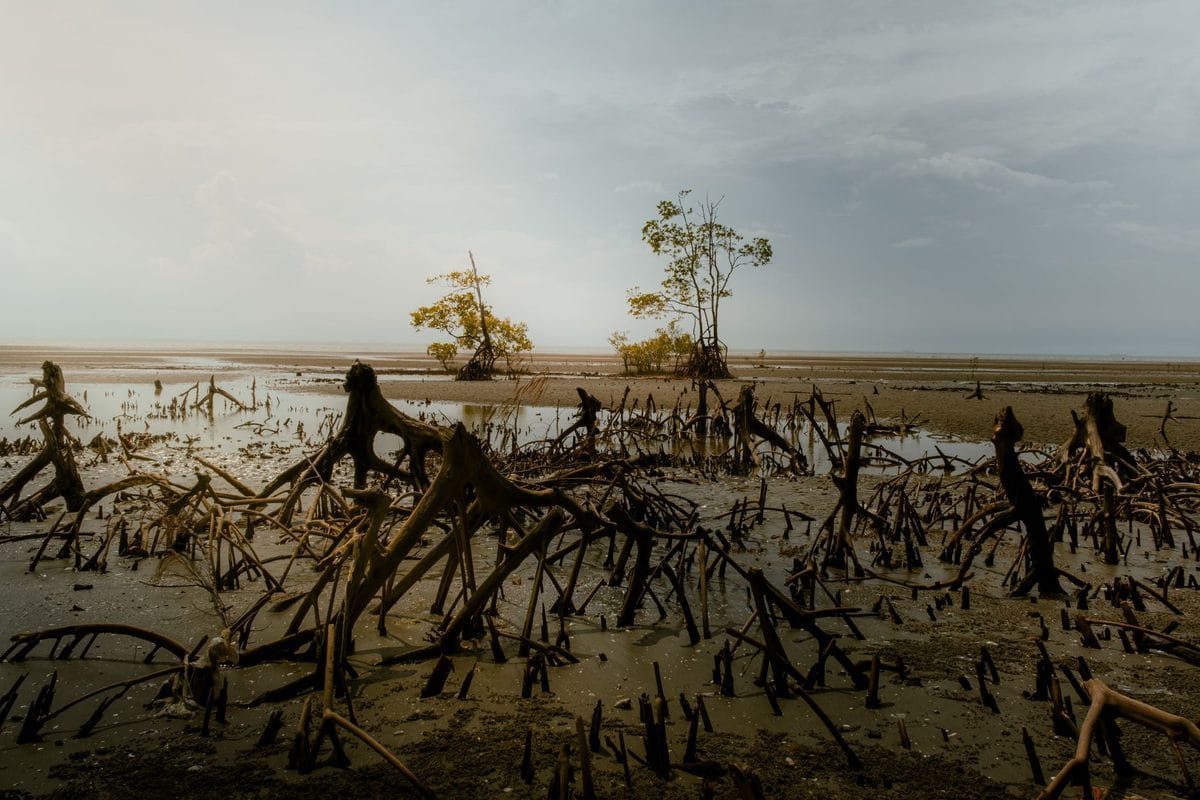
The Clearing and Its Consequences
Mangrove forests once covered extensive stretches of Asia's tropical coastline — from the Sundarbans straddling Bangladesh and India through the archipelagos of Southeast Asia to the coastal lowlands of southern China. Over the second half of the twentieth century, large portions of that coverage were cleared. Aquaculture expansion, primarily shrimp and fish farming, drove the most significant losses across Thailand, Vietnam, Indonesia and the Philippines. Coastal development for urban expansion, tourism infrastructure and salt production removed further hectares. Estimates from the Global Mangrove Alliance and the International Union for Conservation of Nature place cumulative mangrove loss across Asia at more than a third of historical coverage since the 1970s.
The consequences of that loss have been well-documented through multiple regional disasters. Mangroves act as coastal buffers, absorbing wave energy from storms and tidal surges. Areas that had cleared their mangroves suffered substantially higher infrastructure and mortality losses during major cyclones than adjacent areas where forest cover remained intact. The 2004 Indian Ocean tsunami provided the most studied case: coastal communities behind intact mangrove belts in Sri Lanka, Thailand and India recorded lower wave penetration and lower death tolls than comparable communities behind cleared coastlines. Subsequent research by IUCN and regional academic institutions has quantified the protective function, though the precise coefficients vary by forest density, storm type and coastal topography.
Why Aquaculture Drove So Much Loss
The shrimp farming expansion across Southeast Asia followed a simple economic logic: mangrove land was often legally ambiguous in its ownership status, clearing it for ponds required relatively low capital investment, and international demand for farmed shrimp grew rapidly through the 1980s and 1990s. Thailand became one of the world's largest shrimp exporters during this period, and the industry's expansion corresponded directly with the deforestation of coastal mangrove belts in the Gulf of Thailand and the Andaman coast.
The long-run economics proved less favourable than the short-run suggested. Shrimp ponds built on cleared mangrove land are prone to disease outbreak — particularly white spot syndrome virus, which decimated Southeast Asian shrimp farms from the 1990s onward — and the nutrient cycling that intact mangrove systems provide to adjacent coastal fisheries disappears with the forest. Several government studies in Thailand and Vietnam concluded that the total economic value of standing mangrove forest — including fisheries support, storm protection and carbon sequestration — exceeded the value of shrimp production from converted ponds over a comparable time horizon.
The Restoration Push
Mangrove restoration has become one of the more active areas of coastal ecology work across Asia over the past fifteen years. Indonesia, which holds roughly a quarter of the world's remaining mangrove coverage, has established a national restoration target through its Mangrove Ecosystem Restoration Agency and committed significant state budget to planting programmes across Kalimantan, Sumatra and Java. The Philippines has run village-based replanting schemes since the 1990s, with mixed results — some sites showed strong recovery while others failed due to unsuitable species selection or inadequate hydrological assessment.
The species selection problem is a recurring lesson across failed restoration efforts. Mangroves are not a single species — there are over 70 species globally, and each has specific requirements for tidal inundation frequency, salinity range and sediment type. Early restoration programmes across Asia planted Rhizophora species widely because they are visually recognisable, fast-growing and easy to propagate. In many sites, however, Rhizophora is not the ecologically appropriate species for the local hydrological conditions, and the planted trees died within two to three years. Restoration ecologists now emphasise hydrological assessment before planting and species matching to local conditions as prerequisites for durable outcomes.
Carbon Finance and Its Complications
Mangroves store carbon at substantially higher rates per hectare than most terrestrial forests, primarily because of the organic-rich sediments that accumulate in anaerobic conditions beneath the root systems — so-called blue carbon. This has attracted considerable interest from voluntary carbon markets, and a number of blue carbon projects across Indonesia, Myanmar, Vietnam and the Philippines have issued carbon credits based on avoided deforestation or active restoration of mangrove areas.
The quality and permanence of these credits has been contested. Several independently audited reviews found that baseline emissions calculations — the counterfactual deforestation rate against which credits are issued — were in some cases set higher than empirical clearing rates would support, inflating credit volumes. The broader blue carbon accounting framework is under ongoing review by the Verified Carbon Standard and other certification bodies. Meanwhile, the cleared areas themselves remain vulnerable to re-clearing unless secure land tenure and enforcement mechanisms are established alongside any restoration programme — a condition that has proved difficult to guarantee at scale.
Where Recovery Has Worked
The more durable recovery stories tend to share common features. Community-managed restoration in the Sundarbans in Bangladesh has shown consistent canopy recovery over multi-decade monitoring periods where local fishing communities have formal rights to the restored areas and direct economic stakes in their maintenance. Vietnam's Ca Mau province, which lost extensive mangrove cover to shrimp farming, has integrated certified organic shrimp production with mangrove cover requirements — farmers maintain a minimum forest density across their pond area in exchange for premium pricing under forestry-linked aquaculture schemes. The model doesn't fully restore historical forest density, but it stops net clearing and maintains partial ecosystem function.
Recovery is measurable but slow. Mangrove canopy can re-establish within five to ten years under favourable conditions, but the sediment carbon stores that make old-growth mangroves their most ecologically valuable take decades to rebuild.