Delhi Logs Worst October Start in Four Years as Farm-Fire Season Opens Under a Strengthening El Niño
Delhi's air quality index hit 166 on October 1, its worst start to October since 2022, as satellites logged 137 crop-residue fires across northern India. A strengthening El Niño, a dry monsoon and a November 8 Diwali complicate the weeks ahead.
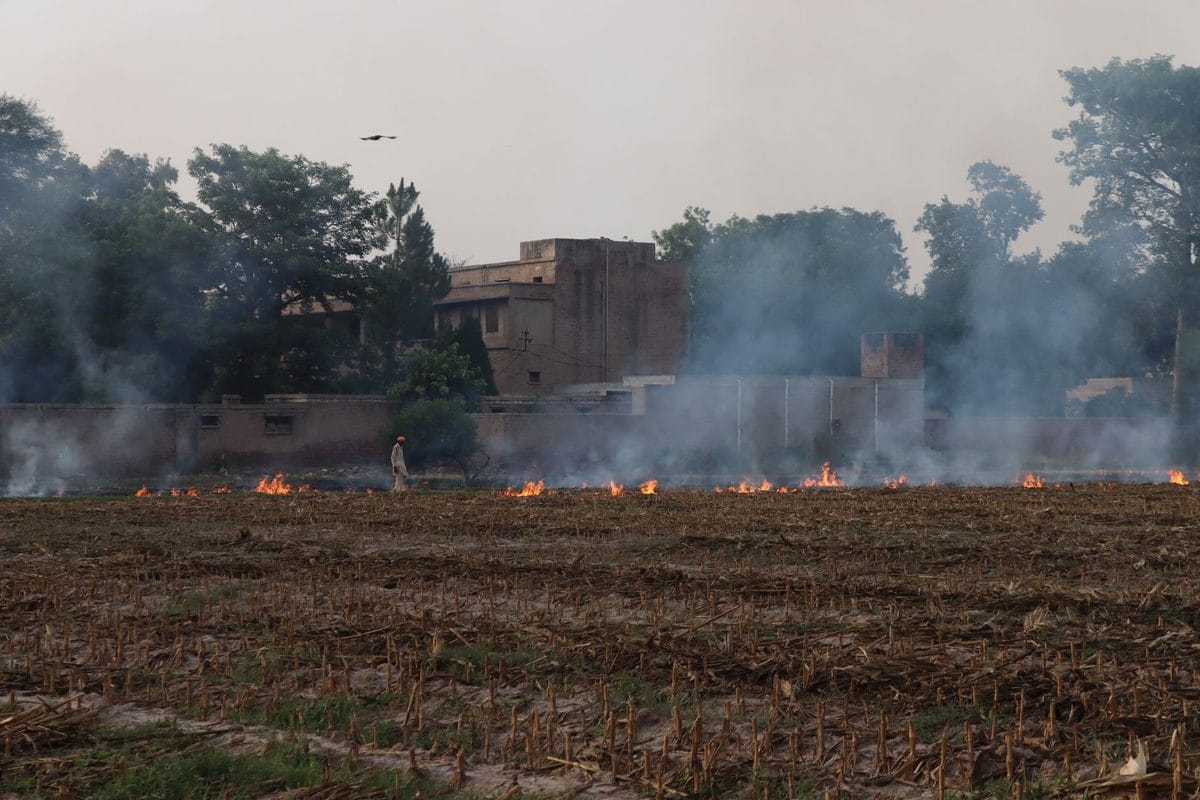
Delhi's air quality index averaged 166 on October 1, its worst reading for the first day of October in four years, as the annual season of crop-residue burning got under way across northern India. The last higher reading for the date was 186 in 2022, according to an analysis by the Centre for Research on Energy and Clean Air (CREA). The index had stood at 129 a day earlier, ending five straight days in the "satisfactory" band, and September had been the capital's cleanest in five years, with an average of 102.
Between September 15 and October 1, the Indian Agricultural Research Institute (IARI) recorded 137 farm-fire events across northern and central India, including 14 in Madhya Pradesh, five in Uttar Pradesh and four in Punjab on October 1 alone. That is a small count by the standards of the season, which generally runs from September 15 to November 30 and typically peaks in the first ten days of November, The Economic Times reported.
A small count ahead of the usual peak
Of the 114 events detected through September 30 across six states, Punjab accounted for 59, just over half the total. Uttar Pradesh followed with 32 and Madhya Pradesh with 17.
| State | Residue-burning events, Sept. 15-30, 2026 |
|---|---|
| Punjab | 59 |
| Uttar Pradesh | 32 |
| Madhya Pradesh | 17 |
| Haryana | 3 |
| Rajasthan | 2 |
| Delhi | 1 |
| Total | 114 |
The early numbers sit on top of a steep multi-year decline in the two states that dominate the Delhi debate. Punjab recorded 5,114 fires in 2025, down from 10,909 in 2024 and 36,663 in 2023, a fall of 86% in two years, while Haryana's count dropped from 1,406 to 662 between 2024 and 2025. Uttar Pradesh moved the other way, rising from 6,142 to 7,290, and Rajasthan edged up from 2,772 to 2,890. In a written reply to the Lok Sabha in March, the environment ministry said Punjab and Haryana together recorded more than 90% fewer fires in the 2025 harvest season than in the same period of 2022.
Satellite tallies have a known gap, as The Economic Times noted: a fire can go undetected if it occurs outside the window when a satellite passes overhead.
El Niño and a dry monsoon complicate the outlook
Daily sea surface temperatures in a key region of the central-eastern Pacific stood 3.05 degrees Celsius above average on September 19, passing the 3.02-degree record set during the very strong El Niño of 2015, the BBC reported on September 22. By the Relative Oceanic Niño Index, which accounts for background ocean warming, the event is not yet a record, and the peak is not expected until later this year.
India's monsoon has followed the usual El Niño pattern. The India Meteorological Department (IMD) said on September 30 that the June-September season ended with 759.4 millimeters of rain against a normal of 868.6, a deficit of 12.6% and the lowest total since 2015. Punjab was rain-deficient in every month from June to September, The Hindu reported from the IMD data.
Gufran Beig, founder of the SAFAR air-quality forecasting system and a chair professor at the National Institute of Advanced Studies, said fewer western disturbances could mean fewer winter rain episodes over Delhi, and that slower winds would let pollutants accumulate near the ground. The Economic Times added that Punjab's rainfall deficit and delayed sowing could push harvesting toward late October and stretch the burning period. Diwali falls on November 8, close to the usual peak of farm-fire activity.
The IMD's director general, M. Mohapatra, offered a partial counterpoint at the September 30 briefing. In El Niño years western disturbances tend to increase, he said, and parts of Punjab, Haryana and neighboring northern states had received good rain in the previous week, leaving soil moisture high for the winter crop. The agency also forecast October rainfall below 85% of normal and above-normal temperatures across most of the country.
Haryana adds drones and a patrol force; Punjab questions FIRs
Haryana has announced the most visible enforcement package of the season. The state will use drone surveillance for the first time and form a Parali Protection Force of police, agriculture and administrative officials, with late-night patrols, The Tribune reported on September 24. Every verified case of paddy stubble burning will draw an FIR, a challan and a "red entry" in the farmer's land records, plus environmental compensation charges.
The state has appointed 8,134 village-level nodal officers for about 621,000 registered paddy farmers across 5,600 villages, each responsible for up to 100 farmers, or 50 in hotspot villages. Farmers who use residue-management machinery are offered 1,200 rupees per acre. Additional Chief Secretary Vijayendra Kumar said patrols are being extended into the night because some farmers burn after dark to avoid satellite detection. Harvesting starts in Yamunanagar, Ambala, Karnal and Kurukshetra in September and reaches Sirsa, Fatehabad, Hisar and Jind in the last week of October.
Punjab is taking a different public line. Chief Minister Bhagwant Mann said in mid-September that he does not favor FIRs against farmers and that growers should receive a cash incentive for managing straw, a demand farm groups put at 3,000 rupees per acre. Sukhdev Singh Kokrikalan, general secretary of the Bharti Kisan Union (Ekta Ugrahan), linked the remarks to the approaching assembly elections and urged the government to cancel FIRs already registered against farmers.
Machines are in place; the market for straw is the next test
Since 2018-19 the central government has released 42.37 billion rupees (4,237.47 crore) under its crop residue management scheme, according to a written reply from Minister of State Kirti Vardhan Singh. States have distributed more than 353,000 machines and set up more than 43,500 custom hiring centers, with subsidies of 50% for individual farmers and 80% for cooperatives, producer organizations and panchayats that run the centers.
For 2026-27, Moneycontrol reported, another 5.44 billion rupees has been provided, and states have set targets of more than 46,000 additional machines, 910 hiring centers and 141 straw supply-chain projects covering an estimated 27.6 million tonnes of paddy residue. The Indian Council of Agricultural Research has itself called for a closer look at how often the machines are used and whether the hiring centers can pay their way.
Moneycontrol's analysis framed the next challenge as demand for the straw itself. Brick kilns in Punjab and the non-NCR districts of Haryana must co-fire paddy-straw pellets or briquettes at 20% from November 2025, rising to 30% from November 1, 2026 and 50% from November 2028, Moneycontrol reported. Coal-fired power plants in the National Capital Region and adjoining areas must blend at least 5% crop-residue pellets under rules notified in 2023.
"Farmers don't burn residue because they don't care about pollution," said Kalpesh Patil, an industrial engineer from a farming family who built a prototype cotton-stalk puller. In his telling, burning is often the only option that fits a farmer's time, budget and available labor.
Delhi's winter plan and how much farm fires matter
The Commission for Air Quality Management (CAQM) reviewed preparations in Delhi, Punjab, Haryana and Uttar Pradesh on September 29. A rule barring fuel sales to vehicles without a valid Pollution Under Control Certificate took effect across the NCR on October 1, with authorities preparing to enforce it using number-plate recognition cameras at fuel and CNG stations, Business Standard reported. The commission is also tracking a planned phase-out of diesel auto-rickshaws across the region by December 31.
The Delhi government's winter plan starts on November 1:
- Dust-generating demolition and outdoor civil construction are banned from November 1 to January 31, with a complete construction and demolition ban from December 10 to January 20.
- Parking charges at authorized sites double through February 28, except at Delhi Metro lots.
- Government and private offices are advised to keep half their staff working from home, and office hours are staggered: 8:30 a.m. to 5 p.m. for municipal corporation offices and 10 a.m. to 6:30 p.m. for Delhi government offices.
Analysts gave the plan a guarded reception. "There's nothing new. Most of these measures have been announced in the past and have been repackaged," said Sunil Dahiya of Envirocatalysts, who called the early announcement the main difference and said 60% to 70% of Delhi's pollution originates outside the city. Manoj Kumar of CREA said the measures "address very few sources from a large pool," noting that secondary particulates can account for 25% to 30% of Delhi's PM2.5 depending on the season.
How much of that load comes from farm fires varies widely. News18 summarized the research: one modeling study put the average contribution of non-local crop-residue burning to Delhi's PM2.5 at about 20% in October and November, while a 2025 study estimated that burning in Punjab alone accounted for about 14% of PM2.5 across Delhi-NCR in October-November 2022. In 2025, the farm-fire share crossed 10% on only eight days and 20% on one, according to Decision Support System data cited by The Economic Times; in 2024 it passed 20% on 14 days.
The Air Quality Early Warning System expects Delhi's air to stay in the "moderate" range from October 2 to 4, then fall between "moderate" and "satisfactory" over the following six days. A ventilation index below 6,000 square meters per second with winds under 10 kilometers per hour, the system warned, is unfavorable for dispersing pollutants.